Interviews play a critical role in the job application process, providing hiring managers and organizations with the opportunity to:
Interact with the candidate in person
Assess key skills and competencies that go beyond the requisite technical skills and background needed for the job
Assess fit of candidate for their team and organizational culture
Cross-reference information obtained from the candidate’s application records, résumé, cover letter, etc.
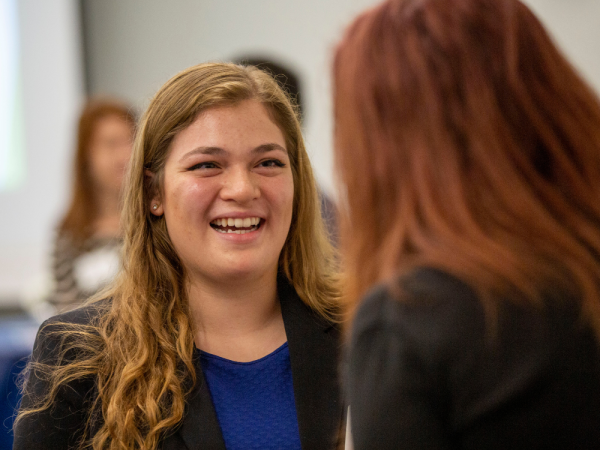
Preparing for Your Interview
1. Meet with a Career Coach
Schedule an appointment with a career coach to discuss the interview process, mock interview, and/or professional events to network and practice your interviewing skills.
2. Research the Company or Organization
Before you interview with any company or organization, you should seek to learn as much as possible about its mission, value, and goals from its website, news stories, and social media. Researching the business will help you:
- Speak authoritatively about the position and improve your overall interview performance
- Ask good, relevant questions that set you apart from other candidates
- Learn more about the employer and better determine if they align with your professional aspirations.
3. Reflect on Your Past Experience and Review Your Resume
Reflecting on your past experiences and applying your skills to the position can help you prepare for answering questions and align the position with your career goals. Review the sample interview questions to get started.
4. Practice Good Interviewing Etiquette
First impressions are just as important as your past experiences. Here’s some tips on how you can make yourself stand out in an interview:
- Dress appropriately and be prepared ahead of time
- Be honest, genuine, and professional
- Be concise in answering questions
- Concentrate on answering one question at time
- Send a thank you follow up after your interview
Types of Interviews
There are several different types of interviews: behaviorally anchored interviews, situational interviews, technical interviews, and traditional interviews. Because employers often use a combination of these methods to obtain the information they need, learning about each one can help you prepare accordingly.
Behavioral interviews focus on the past experiences of the candidates to access certain competencies, skills, behaviors, knowledge, and abilities. The underlying assumption is that if candidates have effectively dealt with such a situation in the past, they are likely to do so in the future as well.
To prepare, think broadly about the competencies employers may be likely to assess you on. Here are some popular examples:
- Making decisions and initiating action
- Supporting and cooperating
- Presenting and communicating information
- Planning and organizing
- Adapting to and working under pressure
- Achieving goals and objectives
When answering questions, you should clearly demonstrate your skills by providing detailed examples of your experiences, what you did, what the outcomes were, and what you learned from them. Consider using the STARR technique:
- Situation – Describe the situation.
- Task – What tasks did you identify that needed to be completed?
- Action– What action did you take?
- Result – What was the result?
- Reflect – What did you learn?
These interviews assess job candidates on their problem-solving skills and how they would react in a specific work-related situation. Situational questions differ depending on the job, but a good strategy is to think about past experiences dealing with difficult situations regarding leadership, working in a team, making mistakes, etc.
To prepare, research the organization and job thoroughly so that you can think about what the employer may consider key responsibilities for the position. Then, proactively think about possible situations you may have to deal with in relation to the job.
While these interviews are most often used in engineering, sciences, and IT roles, graduates of the College of the Liberal Arts may also experience them depending on the position. Technical interviews assess your specific knowledge in that field in order to gauge future job success.
Unlike other types of interviews, technical interviews lend themselves to preparation in the traditional sense. Treat these interviews like an exam and practice the material so you feel confident in communicating it to your interviewers.
While many employers have moved away from traditional interview questions, it’s still a smart strategy to be prepared for them. Traditional interviews assess a candidate’s interest and overall fit with the company and its culture. Often, these questions are used as rapport builders that lead to other types of interview styles.
When preparing for a traditional interview, think about how you would describe yourself and your professional goals to an employer—why you would like to work for them, where you see yourself in a few years, what your strengths and weaknesses are, etc. Be sure to align your responses to the requirements of the job and the overall company culture.
Sample Interview Questions
- Tell me about yourself.
- Why are you interested in this position?
- Tell me about a time you set a goal (academics, work, or student org) and the steps you took to achieve it.
- Give me an example of a time where you demonstrated leadership.
- What is the biggest challenge you faced during COVID-19? How did you overcome these challenges?
- What is one strength and one weakness you bring to this position?
- Tell me about a time you had to be a problem solver and describe the methods you used to solve the issue.
- Tell me about a time you had to work with a difficult person. How did you approach the situation and what was the result?
- What value do you think diversity brings to the workplace?
- What are your short-term and long-term goals?
- Why should we hire you?
- What questions do you have for me?